Notre travail
The work of Long COVID Physio brings together an international, multidisciplinary community of people with lived experience, healthcare professionals, researchers and advocates. Our work spans peer support, education, advocacy and research, with a shared commitment to improving understanding, care and outcomes for people living with, and affected by, Long COVID.
Through collaboration across countries, disciplines and communities, we work to ensure that lived experience is at the heart of research, rehabilitation, healthcare and policy. Explore our work below.
-
Beyond Silos: The BCUHB Living Well Service – a sustainable and scalable model for post-acute infection syndromes
Jones et al. (2026) RESEARCH · CLINICAL PRACTICE
This award-winning poster presented the Betsi Cadwaladr University Health Board Living Well Service, a needs-led model designed to move beyond traditional healthcare silos and provide integrated, sustainable and scalable support for people living with post-acute infection syndromes, including Long COVID and ME/CFS. The poster was awarded Best Poster at the ISLC-PAIS Conference in Amsterdam.
OECD and WHO Europe Long COVID Training Programme
Skipper, Steering Committee member (2026) EDUCATION · ADVOCACY
Lindsay Skipper contributed to the development of an international training course for healthcare professionals, supporting improved understanding of Long COVID and more informed, appropriate and patient-centred care. Used in: OECD and WHO Europe international Long COVID training programme.
Patient and public involvement and engagement in Long COVID research: embedding inclusion in research
Skipper et al. (2026) RESEARCH · ADVOCACY
This paper demonstrates how people with lived experience can be equal partners throughout the research process. It shares practical approaches for meaningful, inclusive and accessible PPIE, helping ensure Long COVID research remains relevant, rigorous and responsive to patient priorities. Published as: Research paper.
Self-management of Long COVID symptoms with over-the-counter medicines and other non-prescribed therapies
Guan et al. (2026) RESEARCH
This study explored how people with Long COVID self-manage their symptoms using over-the-counter medicines, supplements and non-prescribed therapies. The findings highlight the widespread use of these approaches, associated personal costs and the need for clearer guidance to support safe and informed self-management.
UK Covid-19 Inquiry – Module 3: Impact of the pandemic on healthcare systems
Long COVID Core Participant Group (2026) ADVOCACY
As part of the Long COVID Core Participant Group, alongside other core participant groups, Long COVID Physio has contributed to the examination of the pandemic's impact on healthcare systems across the UK. This work helps ensure the experiences and perspectives of people living with Long COVID inform the Inquiry’s evidence, findings and lessons for future healthcare preparedness. Used in: UK Covid-19 Inquiry, Module 3.
Current status and future perspectives on the mechanistic and pathophysiological understanding of Long COVID
Faghy et al. (2026) RESEARCH
This major review brings together evidence on the biological mechanisms underlying Long COVID and identifies priorities for improving diagnosis, treatment and evidence-based care. Impact: Strengthens understanding of Long COVID mechanisms and highlights priorities for future research and clinical practice.
An open-label, clinical feasibility study of the efficacy of Remdesivir for Long-COVID
Neilens et al. (2026) RESEARCH
This study explores the feasibility, safety and potential efficacy of Remdesivir for people living with Long COVID. Impact: Provides evidence to inform the design of future clinical trials and investigation of potential treatment approaches.
Rethinking measurement of health outcomes in Long COVID: Complexities, challenges and considerations
Bhéreur et al. (2026) RESEARCH
This paper examines the challenges of measuring health outcomes in a complex and fluctuating condition. It highlights limitations in conventional outcome measures and the importance of capturing symptom variability, lived experience and the wider impacts of Long COVID. Published in: Health and Quality of Life Outcomes.
Considerations for outcome measurement in Long COVID clinical practice and research: Findings from the Measurement and Assessment Paradigm for Long COVID (MAP LC) study
O’Brien et al. (2026) RESEARCH · EDUCATION
This presentation shared findings from the MAP LC study on selecting meaningful outcome measures for Long COVID clinical practice and research. The work supports clinicians and researchers to make more informed and patient-centred decisions about outcome measurement. Presented at: Rehabilitation Science Research Network for COVID 2026 Special Rehab Grand Rounds, Toronto, Canada.
Co-designing a family-centred care model for Long COVID
Nurgitz et al. (2026) RESEARCH · ADVOCACY
This poster presentation focuses on co-designing a family-centred model of care, emphasising the involvement of people with lived experience and families in shaping rehabilitation and support. Presented at: International Forum on COVID Rehabilitation Research, Toronto, Canada.
Family-centred care for Canadians with Long COVID: Qualitative study
Sessford et al. (2026) RESEARCH · ADVOCACY
This qualitative study explores experiences and perspectives of family-centred care for Canadians living with Long COVID. The findings highlight family and caregiver needs and support the development of more responsive, inclusive and person-centred approaches to care. Presented at: International Forum on COVID Rehabilitation Research, Toronto, Canada.
-
Long COVID Physio Forum: Priorities for Long COVID Rehabilitation
McDuff et al. (2025) RESEARCH · ADVOCACY
This international forum brought together perspectives from people living with Long COVID and rehabilitation professionals to identify priorities for Long COVID rehabilitation. The work highlighted the importance of safe, evidence-informed and person-centred rehabilitation shaped by lived experience. Presented at: International Forum on COVID Rehabilitation Research, Toronto, Canada; 3rd Canadian Symposium on Long COVID.
Episodic disability framework in the context of Long COVID
O’Brien et al. (2025) RESEARCH
This community-engaged international study explored how fluctuating symptoms contribute to episodic disability among people living with Long COVID. The findings advanced understanding of how disability changes over time and its implications for rehabilitation, research, policy and support. Presented at: International Forum on COVID Rehabilitation Research, Toronto, Canada; World Physiotherapy Congress, Tokyo, Japan.
Sensibility of the Episodic Disability Questionnaire among adults with Long COVID
Nathanson et al. (2025) RESEARCH
This study examined how well the Episodic Disability Questionnaire captures the experiences of adults living with Long COVID. The findings support the development of meaningful, accessible and patient-centred approaches to measuring episodic disability. Presented at: International Forum on COVID Rehabilitation Research, Toronto, Canada; 3rd Canadian Symposium on Long COVID.
Community-engaged Long COVID research: Processes, evaluation and recommendations
O’Hara et al. (2025) RESEARCH · ADVOCACY
This work explored how people with lived experience and communities can be meaningfully involved throughout the Long COVID research process. The findings provide recommendations for strengthening inclusive, effective and sustainable approaches to community-engaged research. Presented at: International Forum on COVID Rehabilitation Research, Toronto, Canada; 3rd Canadian Symposium on Long COVID.
Person and family-centred care for Long COVID: Qualitative study
Wu et al. (2025) RESEARCH · ADVOCACY
This qualitative study explored perspectives on person- and family-centred care for people living with Long COVID. The findings highlighted the importance of involving people with lived experience and families in shaping care that is responsive to their needs and priorities. Presented at: International Forum on COVID Rehabilitation Research, Toronto, Canada.
Establishing a framework of measurement for use in Long COVID research and practice
McDuff et al. (2025) RESEARCH
This protocol sets out a structured approach to identifying and evaluating how health outcomes are measured in Long COVID research and practice. The work aims to support more consistent, meaningful and patient-centred measurement across the field. Presented at: International Forum on COVID Rehabilitation Research, Toronto, Canada.
Mixed methods study of views and experience of non-hospitalised individuals with Long COVID of using pacing interventions
McMullan et al. (2025) RESEARCH
This study explored the experiences of people with Long COVID using pacing to manage their symptoms and daily activities. Findings suggest pacing can support activity planning and motivation, while highlighting challenges including fatigue, time constraints and the need for clearer guidance.
Pacing to reduce symptom exacerbation: Results from an international community-engaged study
McDuff et al. (2025) RESEARCH
This international community-engaged study explored how people with Long COVID use pacing to manage symptom exacerbation across Canada, Ireland, the United Kingdom and the United States. The findings highlighted pacing as an individualised and adaptive strategy shaped by fluctuating symptoms and daily demands. Presented at: World Physiotherapy Congress, Tokyo, Japan.
Research priorities in COVID rehabilitation: A framework from the Rehabilitation Science Research Network for COVID
O’Brien et al. (2025) RESEARCH
This framework outlined priorities for advancing COVID-19 rehabilitation research. It identified key areas for future research and collaboration to strengthen the evidence base and improve rehabilitation for people affected by COVID-19 and Long COVID. Presented at: World Physiotherapy Congress, Tokyo, Japan.
Experiences of physiotherapists working with adults living with Long COVID in Canada: A qualitative study
Wong et al. (2025) RESEARCH · EDUCATION
This qualitative study explored physiotherapists’ experiences of supporting adults living with Long COVID. The findings highlighted challenges in clinical practice and the need for improved education, guidance and support for rehabilitation professionals. Presented at: World Physiotherapy Congress, Tokyo, Japan.
Improving Occupational Rehabilitation for People Living with Long COVID
DeMars et al. (2025) RESEARCH · ADVOCACY
This work highlighted the need for more responsive approaches to supporting people with Long COVID in returning to and remaining in work. It emphasised individualised, flexible and multidisciplinary occupational rehabilitation that recognises fluctuating symptoms and the challenges of sustaining employment.
Long COVID clinical evaluation, research and impact on society: A global expert consensus
Ewing et al. (2025) RESEARCH · ADVOCACY
This global expert consensus brought together international expertise and lived-experience perspectives to develop recommendations on the clinical evaluation, research and societal impact of Long COVID. The recommendations support more consistent, person-centred approaches to assessment, research and care worldwide.
Priorities for Research, Education, Clinical Practice, and Policy From the Long COVID Physio International Forum
McDuff et al. (2025) RESEARCH · ADVOCACY
This international study brought together perspectives from 794 respondents across 34 countries, including people living with Long COVID. The findings identified priorities spanning research, education, clinical practice and policy to help shape safer, more person-centred approaches to Long COVID.
More than “brain fog”: Cognitive dysfunction and the role of occupational therapy in Long COVID
Skiffington and Breen (2025) RESEARCH · EDUCATION
This work explored the impact of cognitive dysfunction on people living with Long COVID. It highlighted the role of occupational therapy in supporting cognitive function, daily activities and participation through personalised, practical and meaningful interventions.
UK Covid-19 Inquiry – Module 3: Impact of the pandemic on healthcare systems
Long COVID Core Participant Group (2025) ADVOCACY
As part of the Long COVID Core Participant Group, Long COVID Physio contributed to the joint Closing Statement on behalf of the Long COVID Groups. The statement brought together evidence on the impact of Long COVID and called for meaningful action to address healthcare inequalities, research gaps, patient safety and long-term support.
Measurement and assessment paradigm for Long COVID (MAP LC)
O’Brien et al. and McDuff et al. (2025) RESEARCH
This work explored how outcomes are measured in Long COVID research and practice, including the experiences of people living with Long COVID and their caregivers. The findings highlighted the need for meaningful, consistent, accessible and comprehensive approaches to capturing the complexity of Long COVID. Presented at: 3rd Canadian Symposium on Long COVID.
Developing a Canadian consensus definition of Long COVID
Brehon et al. (2025) RESEARCH
This work explored the development of a shared Canadian definition of Long COVID. The aim was to support greater consistency in how Long COVID is understood, identified and studied across research and clinical practice. Presented at: 3rd Canadian Symposium on Long COVID.
Co-designing a model of person- and family-centred care for Canadians affected by Long COVID
Sessford et al. (2025) RESEARCH · ADVOCACY
This protocol outlines a co-design approach to developing a person- and family-centred model of care. The work emphasises meaningful involvement of people with lived experience and families in shaping future Long COVID care and support. Presented at: 3rd Canadian Symposium on Long COVID.
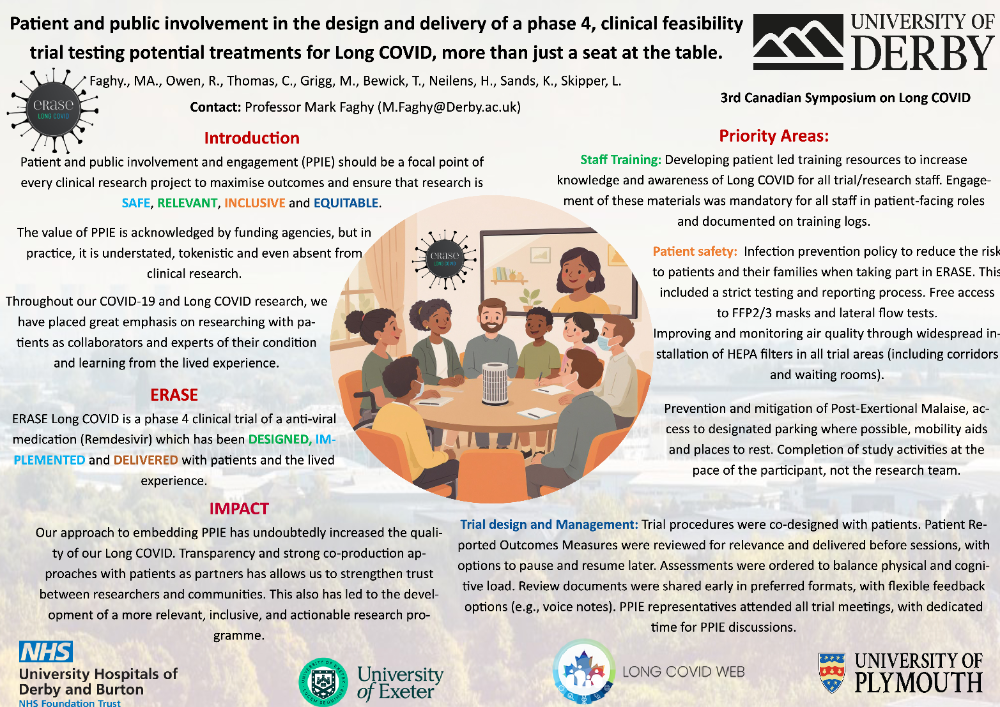
Patient and public involvement in the design and delivery of a phase 4 clinical feasibility trial testing potential treatments for Long COVID: More than just a seat at the table
Faghy et al. (2025) RESEARCH · ADVOCACY
This work demonstrated how meaningful patient and public involvement can influence the design and delivery of clinical research. It highlighted how lived experience can be embedded throughout the research process. Presented at: 3rd Canadian Symposium on Long COVID.
Long COVID and episodic disability: Applying lessons learned from the field of HIV, disability and rehabilitation
O’Brien (2025) EDUCATION
This presentation explored how learning from HIV, disability and rehabilitation can inform understanding of Long COVID and episodic disability. It highlighted the importance of recognising fluctuating disability and developing responsive, person-centred approaches to rehabilitation and support. Presented at: Guy’s and St Thomas’ NHS Foundation Trust; University of Stirling.
CAN-PCC guidelines: Pharmacological and non-pharmacological interventions
Quinn et al. (2025) EDUCATION
This presentation shared evidence-informed guidance on pharmacological and non-pharmacological interventions for people living with Long COVID. It supported healthcare professionals to understand current recommendations and apply appropriate, person-centred approaches to Long COVID care. Presented as part of: Global Long COVID ECHO Webinar Series.
Evidence-informed recommendations to improve the care of Canadians living with post-COVID-19 condition
O’Brien and Quinn (2025) ADVOCACY
This presentation shared evidence-informed recommendations for improving care for Canadians living with Long COVID. It highlighted priorities for coordinated, appropriate and person-centred approaches to assessment, management and ongoing support. Presented as part of: University of Saskatchewan CAN-PCC programme.
Family and caregiving
McFarland et al. (2025) EDUCATION · ADVOCACY
This presentation explored the experiences and challenges faced by families and caregivers supporting people living with Long COVID. It highlighted the importance of recognising caregiver needs and incorporating family perspectives into research, rehabilitation and support. Presented at: Rehabilitation Science Research Network for COVID Fireside Chat.
-
Profiling the persistent and episodic nature of Long COVID symptoms and the impact on quality of life and functional status
Owen et al. (2024) RESEARCH
This study provides important evidence of the fluctuating and relapsing nature of Long COVID. The findings highlight its significant impact on quality of life, functional status and wellbeing, strengthening understanding of the lived experience of Long COVID.
Implementation of patient and public involvement and engagement (PPIE) for the Therapies for Long COVID in non-hospitalised individuals (TLC) project
Aiyegbusi et al. (2024) RESEARCH · ADVOCACY
This paper describes how people with lived experience of Long COVID were actively involved throughout the TLC research project. It highlights practical approaches to collaborative and inclusive PPIE, demonstrating how patient partners can help shape research design, delivery and dissemination to ensure research remains relevant to patient needs.
Citizen Engaged Approaches to COVID Rehabilitation Research – Community Engagement in Rehab Research: A Year in Review
O’Hara et al (2024) RESEARCH · ADVOCACY
This presentation shared learning from a year of community engagement in COVID-19 rehabilitation research. It highlighted the value of involving people with lived experience in shaping research priorities, processes and outcomes. Presented at: International Forum on COVID Rehabilitation Research, Toronto, Canada.
Patient Engagement Special Interest Group (PE-SIG) Discussion
Felicity Jeyes, Yvonne Alder, Christel Mc Mullan (2024) ADVOCACY · EDUCATION
This group discussion brought together researchers and patient partners to explore approaches to meaningful and inclusive patient engagement in quality-of-life research. It supported shared learning on strengthening the patient voice, improving research partnerships and ensuring research reflects outcomes that matter to patients. Presented at: ISOQOL 31st Annual Conference, Cologne, Germany.
Improving standards for Patient and Public Involvement and Engagement in Health Research
Christel McMullan, Yvonne Alder and Felicity Jeyes (2024) RESEARCH · ADVOCACY
This oral presentation explored approaches to improving standards for meaningful Patient and Public Involvement and Engagement (PPIE) in health research. Drawing on lived experience and research collaboration, it highlighted the importance of inclusive and effective partnerships between researchers and patient contributors. Presented at: ISOQOL 31st Annual Conference, Cologne, Germany.
Opening Statement to the UK Covid-19 Inquiry – Module 3
Long COVID Physio (2024) ADVOCACY
As one of the Core Participant Groups for Module 3 of the UK Covid-19 Inquiry, Long COVID Physio contributed an Opening Statement presenting the experiences and perspectives of people affected by Long COVID. The statement highlighted the significant and lasting impact of the condition and the importance of learning from lived experience to inform future healthcare policy, preparedness and response.
Rehabilitation Science Research Network for COVID
O’Brien and Cameron (2024) EDUCATION
This presentation introduced the Rehabilitation Science Research Network for COVID and its collaborative approach to COVID-19 rehabilitation research. It highlighted opportunities for collaboration, knowledge sharing and community engagement to advance rehabilitation research and improve outcomes. Presented at: Rehabilitation Sciences Graduate Student Union Speaker Series, University of Toronto, Toronto, Canada.
Key considerations for digital decentralised clinical trials from a feasibility study assessing pacing interventions for Long COVID
McMullan et al. (2024) RESEARCH
This study explored the feasibility of using a digital decentralised clinical trial to assess pacing interventions for people with Long COVID. It highlights the potential of remote trials to improve accessibility while identifying challenges around recruitment, participant retention and data collection that should inform future Long COVID research.
Where are we at? Highlighting the current landscape of rehabilitation in Long COVID
O’Brien et al. (2024) EDUCATION
This webinar provided an overview of the evolving rehabilitation landscape for Long COVID. It brought together current knowledge and perspectives to highlight ongoing challenges, evidence gaps and priorities for improving rehabilitation approaches for people living with Long COVID. Presented as part of: Long COVID Web Webinar Series.
Experiences of physiotherapists working with adults living with Long COVID in Canada: A qualitative study
Kim et al. (2024) RESEARCH · EDUCATION
This qualitative study explored physiotherapists’ experiences of supporting adults living with Long COVID. The findings highlighted challenges in assessment and management, the need for greater education and clinical guidance, and the importance of collaborative and individualised approaches to rehabilitation. Presented at: Ontario Physiotherapy Association InterACTION Conference, Toronto, Canada; International Forum on COVID Rehabilitation Research, Toronto, Canada; 2nd Canadian Symposium on Long COVID, Edmonton, Canada.
“It’s a moving target”: Experiences of pacing to reduce symptom exacerbation among adults living with Long COVID
McDuff et al. (2024) RESEARCH
This international, community-engaged study explored the experiences of adults using pacing to manage symptom exacerbation. The findings highlighted the individualised and evolving nature of pacing and the importance of adapting activity to fluctuating symptoms and daily demands. Presented at: 2nd Canadian Symposium on Long COVID, Edmonton, Canada.
Prevalence of post-acute sequelae of SARS-CoV-2 infection in people living with HIV: A systematic review with meta-analysis
Pouliopoulou et al. (2024) RESEARCH
This systematic review and meta-analysis examined the prevalence of Long COVID among people living with HIV. The findings highlighted the ongoing burden of post-COVID-19 symptoms in this population and the need for greater understanding of their specific healthcare needs.
Increasing access to clinical trials for vulnerable patients: Public Involvement and Long COVID
Neilens et al. (2024) RESEARCH · ADVOCACY
This presentation explored how meaningful public involvement can improve access to clinical research for people who may otherwise be excluded. It highlighted the importance of inclusive trial design and ensuring diverse patient voices shape clinical research. Presented at: International Clinical Trials Methodology Conference, Edinburgh, Scotland, UK.
Establishing a framework of measurement for Long COVID research and practice
McDuff et al. (2024) RESEARCH
This protocol set out a structured approach to developing a framework for measuring outcomes in Long COVID research and practice. The work aims to support more consistent, meaningful and patient-centred measurement across the field. Presented at: 2nd Canadian Symposium on Long COVID, Edmonton, Canada.
Conceptual framework of episodic disability in the context of Long COVID
O’Brien et al. (2024) RESEARCH
This international community-engaged study explored how fluctuating symptoms contribute to episodic disability among people living with Long COVID. The work developed a framework to improve understanding of episodic disability and inform research, rehabilitation, policy and support. Presented at: 2nd Canadian Symposium on Long COVID, Edmonton, Canada.
Research priorities in COVID rehabilitation: A framework from the Rehabilitation Science Research Network for COVID
O’Brien et al. (2024) RESEARCH
This framework outlined priorities for advancing COVID-19 rehabilitation research. It highlighted key areas for future research and collaboration to strengthen the evidence base and improve rehabilitation for people affected by COVID-19 and Long COVID. Presented at: 2nd Canadian Symposium on Long COVID, Edmonton, Canada.
-
Long COVID quality of life and healthcare experiences in the UK: A mixed method online survey
Owen et al. (2023) RESEARCH
This mixed-method online survey explored the lived experiences of 132 people living with Long COVID. The findings demonstrated the significant impact of Long COVID on quality of life and daily activities, while highlighting barriers to care, inadequate support and the need for more appropriate, patient-centred healthcare services.
Acute COVID-19, the lived experience, and lessons to learn for future pandemics
Owen et al. (2023) RESEARCH
This study explored the experiences of people during the acute phase of COVID-19, including those who managed their illness in the community. The findings highlighted gaps in care and support and identified important lessons to strengthen preparedness for future pandemics and public health emergencies.
Forming a consensus opinion to inform Long COVID support mechanisms and interventions: A modified Delphi approach
Owen et al. (2023) RESEARCH
This modified Delphi study brought together people with Long COVID, healthcare professionals and researchers to develop consensus on appropriate support. The study identified 55 areas of consensus, supporting personalised care, pacing, symptom management and comprehensive, patient-centred approaches to Long COVID.
Long COVID – Integrated Approaches to Chronic Disease Management?
Faghy et al. (2023) RESEARCH · ADVOCACY
This paper highlighted the need for a coordinated, multidisciplinary approach to managing Long COVID as a complex, chronic condition. It advocated collaboration across clinical specialisms and integrated care pathways to better address the diverse and ongoing needs of people living with Long COVID.
Co-production of a feasibility trial of pacing interventions for Long COVID.
Turner et al. (2023) RESEARCH
This study highlights the value of co-production in developing a feasibility trial of pacing interventions for Long COVID. The findings demonstrate the importance ofincorporating the experiences and perspectives of people living with Long COVID to ensure that pacing interventions are acceptable, relevant and responsive to their needs.
Qu'est-ce qu'une réhabilitation sûre COVID Long ?
DeMars et al. (2023) RESEARCH · ADVOCACY
This work explored what constitutes safe and appropriate rehabilitation for people living with Long COVID. It highlighted the need to recognise post-exertional symptom exacerbation, individualise rehabilitation and avoid approaches that may cause harm, supporting safer, more responsive and person-centred rehabilitation practice.
Conceptualising the episodic nature of disability among adults living with Long COVID
O’Brien et al. (2023) RESEARCH
This international community-engaged qualitative study explored how fluctuating symptoms can create periods of disability that vary over time. The work highlighted the importance of recognising episodic disability in Long COVID to better inform assessment, support, research and policy. Presented at: Long COVID Web Symposium, Montreal, Canada; World Physiotherapy Congress, Dubai, United Arab Emirates.
Developing a framework of measurement in the context of Long COVID
O’Brien (2023) RESEARCH
This presentation explored how health outcomes should be measured in Long COVID research. It highlighted the need for meaningful, consistent and patient-centred measures that reflect the complex and fluctuating nature of the condition. Presented at: Long COVID Web Priority Setting Meeting, Toronto, Canada.
Long COVID as an example for bringing visibility to invisible disabilities
Brown et al. (2023) RESEARCH · ADVOCACY
This presentation explored Long COVID as an exemplar of invisible disability and complex chronic illness. The session highlighted the importance of lived experience, patient activism and safe, evidence-based rehabilitation in improving understanding and inclusion for people living with invisible disabilities. Presented at: World Physiotherapy Congress, Dubai, United Arab Emirates.
Considerations for patient and public involvement and engagement in health research
Aiyegbusi et al. (2023) RESEARCH · ADVOCACY
This review examines the role and impact of patient and public involvement and engagement (PPIE) within the Long COVID TLC Study. It identifies good practice and areas for improvement, providing practical considerations to support more meaningful and effective involvement of patients and the public in future health research.
Ageing, episodic disability, and rehabilitation: Lessons learned from adults ageing with HIV engaging in exercise and physical activity
O’Brien and Ibanez-Carrasco (2023) EDUCATION
This seminar explored lessons from HIV rehabilitation that can inform understanding of episodic disability. It highlighted the importance of adapting rehabilitation approaches to support people living with fluctuating and lifelong health conditions. Presented at: University of Manchester, Manchester, UK.
HIV in Motion: Community-engaged participatory approaches to HIV and rehabilitation research and knowledge mobilization
O’Brien and Ibanez-Carrasco (2023) EDUCATION
This seminar explored community-engaged approaches to HIV and rehabilitation research and knowledge mobilisation. It highlighted the value of meaningful community participation in research and sharing knowledge with the communities it aims to serve. Presented at: University of Manchester, Manchester, UK.
Co-production of a feasibility trial of pacing interventions for Long COVID
Turner et al. (2023) RESEARCH · ADVOCACY
This study describes the co-production of a feasibility trial of pacing interventions for people with Long COVID. People with lived experience helped select pacing resources and co-design study processes, materials and dissemination, demonstrating the value of patient involvement in shaping relevant and accessible Long COVID research.
Understanding Long COVID and episodic disability to inform rehabilitation approaches
O’Brien and Malli (2023) EDUCATION
This webinar explored the relationship between Long COVID, episodic disability and rehabilitation. It shared evidence and practical insights to support more responsive, individualised and person-centred approaches to rehabilitation. Presented for: Canadian COVID-19 Network of Clinical Trials Networks.
Long COVID and episodic disability: Considerations for rehabilitation
O’Brien and Skiffington (2023) EDUCATION
This webinar explored the implications of episodic disability for Long COVID rehabilitation. It highlighted the importance of recognising fluctuating symptoms and adapting rehabilitation approaches to support individual needs, participation and daily life. Presented for: Canadian Association of Occupational Therapists.
-
Is Long COVID the Next Global Health Crisis?
Faghy et al. (2022) RESEARCH · ADVOCACY
This paper brought together emerging evidence and patient perspectives to highlight Long COVID as a growing global health challenge. It called for greater awareness, investment in research and collaboration across disciplines to address the significant health, social and economic impacts of the condition.
Recommendations for Employers, Insurers, Human Resource Professionals on Return to Work for People Living with Long COVID
DeMars et al. (2022) ADVOCACY
These recommendations provided practical guidance to support people living with Long COVID to return to and remain in work. They emphasised flexible, individualised approaches that recognise fluctuating symptoms, disability and the need for workplace accommodations.
Long COVID and episodic disability: Advancing the conceptualisation, measurement and knowledge of episodic disability among people living with Long COVID
O’Brien et al. (2022) RESEARCH
This work established a framework for understanding how fluctuating symptoms can create episodic disability among people living with Long COVID. The study aims to improve how disability is conceptualised and measured, supporting more responsive research, clinical practice and policy.
Intolérance orthostatique, dysautonomie et POTS
Strain et al. (2022) EDUCATION
This session brought together clinical and lived-experience perspectives on autonomic dysfunction in Long COVID. It explored recognition, assessment and management of orthostatic intolerance, dysautonomia and POTS, supporting greater awareness and safer, more informed rehabilitation approaches for people living with Long COVID. Presented at: Long COVID Physio International Forum.
Long COVID and episodic disability: Lessons learned from HIV rehabilitation
O’Brien (2022) EDUCATION
This presentation explored how lessons from HIV rehabilitation can inform understanding and support of episodic disability in Long COVID. It highlighted the value of adapting established rehabilitation knowledge to address emerging challenges in Long COVID. Presented at: St. John’s Rehabilitation Research Rounds, Toronto, Canada.
Long COVID, episodic disability and rehabilitation
O’Brien (2022) ADVOCACY
As an invited witness before the House of Commons Standing Committee on Health in Canada, O’Brien presented evidence on Long COVID, episodic disability and rehabilitation directly to policymakers. The presentation highlighted the need for appropriate support, recognition of fluctuating disability and informed approaches to rehabilitation. Presented to: House of Commons Standing Committee on Health, Canada.
Episodic disability
O’Brien (2022) RESEARCH
This presentation explored how fluctuating symptoms can create periods of disability that vary over time. It highlighted the importance of recognising episodic disability in Long COVID and its implications for rehabilitation, support, research and the wider understanding of living with the condition. Presented at: Long COVID Physio International Forum.
First National Deliberative Dialogue on Long COVID, episodic disability, and employment in Canada
O’Brien (2022) EDUCATION · ADVOCACY
This presentation brought together perspectives on the impact of Long COVID and episodic disability on employment. It highlighted the importance of inclusive workplace practices, appropriate support and greater recognition of fluctuating disability. Presented at: Understanding Long COVID event, Canada.
Rehabilitation Science Research Network for COVID
O’Brien et al. (2022) EDUCATION
This presentation introduced the Network’s collaborative approach to COVID-19 rehabilitation research. It highlighted the importance of bringing together researchers, clinicians and people with lived experience to advance rehabilitation knowledge and improve outcomes. Presented at: Leadership Rehabilitation Rounds, University of Toronto, Toronto, Canada.
Opportunities for international collaborations and capacity building in Long COVID and COVID-19 rehabilitation research
O’Brien et al. (2022) RESEARCH
This presentation explored opportunities to strengthen international collaboration and research capacity in Long COVID and COVID-19 rehabilitation research. It highlighted the importance of connecting researchers, clinicians and people with lived experience to advance rehabilitation research and knowledge. Presented at: American Congress of Rehabilitation Medicine Annual Conference.
Conceptualizing the episodic nature of disability among adults living with Long COVID: Qualitative study
O’Brien et al. (2022) RESEARCH
This international qualitative study explored how fluctuating symptoms contribute to periods of disability among adults living with Long COVID. The findings supported greater recognition of episodic disability in rehabilitation, research, policy and practice. Presented at: American Congress of Rehabilitation Medicine Annual Conference.
Visit our Past Work and Early Work pages to discover our earlier contributions.
Date Last Revised: 11th September 2026